
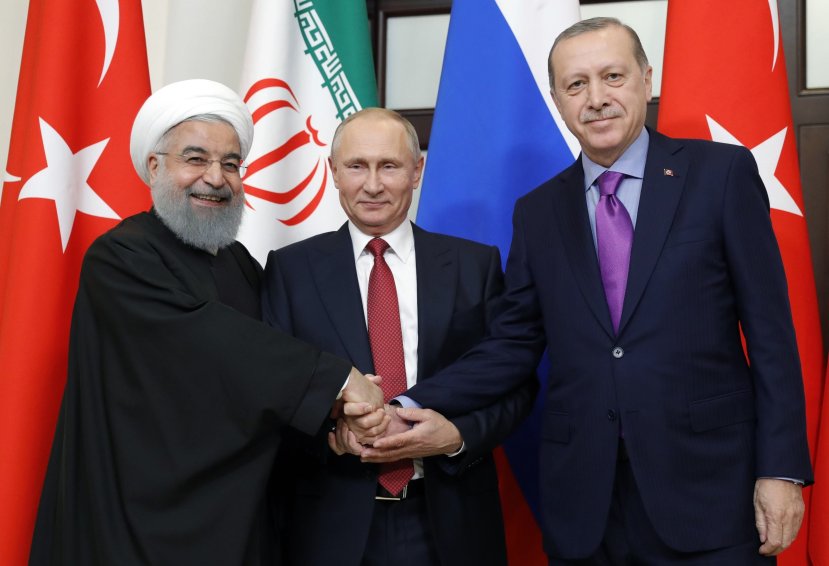
Putin hosts Turkish and Iranian Presidents. PHOTO: MIKHAIL METZEL/AGENCE FRANCE-PRESSE/GETTY IMAGES
Pompeo & Bolton Push Back on Iran, as Putin & Khamenei Push into Idlib
Frantzman Summarizes the Emergence of a New Iran Policy
Seth J. Frantzman laid out the contours of a concerted Pompeo-Bolton policy of containment against Iran on Monday at The National Interest, drawing attention to the mostly unnoticed Section 1237 of the National Defense Authorization Act (NDAA) that was signed by President Trump on August 6. As Frantzman notes, Section 1237 includes a clause stipulating that “the Secretary of Defense, with concurrence of the Secretary of State, may develop a strategy with foreign partners to counter the destabilizing activities of Iran.” This is exactly what Secretary of State Mike Pompeo has done, assisted in large part by his like-minded ally in the Trump Administration, National Security Advisor John Bolton. Summarizing the developments, Frantzman writes:
“Taken as a whole, between the NDAA’s calls on the Defense Department to come up with a strategy, the new Iran Action Group at the State Department, the U.S.-led coalition’s active role in Syria, and Bolton’s Jerusalem visit, a wide-ranging policy on Iran has finally taken shape a year and a half after Trump took office. This is primarily a product of the Bolton-Pompeo team.
Mattis is a key to the new policy as well. He called Iran an ‘exporter of instability across the region,’ at a July press conference. He said nothing had changed the ground in terms of confronting Iran. He stressed that the fight against ISIS was ‘by, with and through,’ the U.S. partners in Syria and that the United States would not ‘put U.S. troops in to provide the security.’ Instead the United States would be going back to Geneva to pursue the diplomatic track.”
Incoherence on Russia Policy Necessarily Affects Iran Policy
This sounds well enough, and Pompeo, Bolton, Mattis, and Haley, have all long been recognized as foreign policy hawks in the U.S. establishment. However, few people have remarked upon how the incoherence of the Trump Administration’s posture toward Russia necessarily affects its Iran policy. Many commentators have remarked that while President Trump himself has seemed beholden to Putin, and has worked to advance Russian interests to the detriment of Western nations, nonetheless, the bureaucratic machinery, even within his own administration, has taken orthodox policy stances against Russia, supporting NATO allies, opposing Russian involvement in Syria, supporting arms transfers to Ukrainian rebels, vocally criticizing political oppression within Russia, and enforcing increasingly harsh sanctions against the criminal hybrid state of Putin himself. Again, this sounds like it could work well enough, except of course, that there are deeper problems, because what the President says and does actually matters. Moreover, the degree of involvement of the Trump campaign and the Trump Administration with Russia calls into question the degree to which members within the Trump Administration can effectively coordinate a policy to oppose the Iranian regime of Ayatollah Khamenei.
Bolton, for example, was a very early and enthusiastic stakeholder in the Cambridge Analytica development of weaponized political disinformation on social media to influence domestic elections. Given the ties Cambridge Analytica has to oligarch, Dmitry Firtash, and to Russian intelligence services (RIS) through the work of Aleksandr Kogan at Cambridge University and the University of St. Petersburg; and the suspected data laundering of micro-targeting information through intermediaries such as Peter Thiel, Steve Bannon, and Jared Kushner; the early ties of Cambridge Analytica to John Bolton’s super PACs is troubling, and calls into question his willingness or ability to lead an effective policy response against Russian interests. Given his noted ability during the North Korean summit to happily endorse positions that are in direct contradiction to those he has elucidated for decades, it must be noted that he is prone to being compromised.
Pompeo, despite being a noted foreign policy hawk, happily repeated WikiLeaks talking points (i.e., political disinformation against the U.S. directed by RIS) in an effort to discredit Hillary Clinton during the 2016 campaign. As someone who has long been familiar with U.S. intelligence circles, and who would later go on to direct the CIA, he should have known better; and he did.
Mattis, despite his reputation, is no real hawk on Iran, nor on Russia, and has repeatedly praised the JCPOA negotiated between the Obama Administration and Iran as something that would be in the U.S. interest to maintain. This is not to impugn his character or integrity, but only to say that he cannot be counted as a reliable hawk on Russia.
The Ongoing Humanitarian Catastrophe in Syria Rolls Toward Idlib
The incoherence of the Trump Administration’s Russia policy vis-a-vis its Iran policy matters, because it can be seen time and time again that Russian and Iranian interests are intertwined in an axis of opposition to international (and especially Western) norms on human dignity and freedom that are part of the current U.S.-led, post-WWII global era. This has always been the case during the Syrian Civil War that began in 2011, and which the Obama Administration ceded to Russia, to catastrophic effect for U.S. interests. Whereas 10 previous U.S. Presidents had successfully prevented Russia from establishing a physical presence in the Middle East, President Obama almost seemed to welcome it as part of his grand bargain with Iran (the centerpiece of his entire foreign policy across two terms), and then made hand-waving rationalizations about how Russia would soon get bogged down in a “quagmire” and recognize the error of its ways. That never happened, obviously, and in the past couple of weeks we have seen Russia trumpet the buildup of its naval warships off the coast of Syria, and give support to the recently launched Russo-Iranian offensive into Idlib province, which onlooking observers have warned is a recipe for humanitarian disaster (and also a geopolitical disaster, as nations in opposition to Iran seek to fight back in the larger regional proxy wars), and one that is likely to be even worse than Aleppo or Homs.
In the Democrat-friendly media, of course, there is a reflexive opposition to anything resembling muscular foreign policy by the U.S., and many anti-Trump voices have taken to warning against Pompeo, Bolton, and the Trump Administration “warmongering” against the Iranian regime. In a rationalization of twisted logic, the foreign policy doves and so-called “realists” have taken to arguing that the Trump Administration is planning to attack Iran, because this is what Putin wants. Nothing could be further from the truth.
There will of course always be issues of separation between Russia and Iran, and RIS has effectively used the prospect of U.S.-Russian cooperation against Muslim terrorism as an enticement to get politically powerful persons to betray U.S. interests. (The most obvious examples here would be Michael Flynn and Erik Prince, although many other persons aligned with the Trump Administration would also fit the bill.)
In reality, Putin will never cooperate with the U.S. to help solve the political problem of Islamic terrorism in the Middle East. Given that Putin effectively runs a mafia hybrid-state, his only interest is in bolstering a motley group of rogue regimes aligned only by the singular interest of thwarting U.S.-led efforts at global sanctions and U.S. support for small states threatened by rogue state aggression. That is why he will always stand by the regime in Iran, even as he jostles with Iran, and uses negotiations with Israel and other states as leverage to try to get Iran to leave Syria to Russian influence. Regardless of the Russia-versus-Iran jockeying for position in controlling the scraps from the Assad regime (which is now an ineffective puppet state controlled by two rival foreign powers) though, Russia and Iran will always agree that the continuation of the Assad regime (if not the Assad family) are to their mutual benefit.
Will Russia successfully negotiate terms between Iran and Israel to keep the Iranian military presence removed from Israel’s borders? Probably not. In any case, Hezbollah is now building an extensive system of surface-to-surface missiles within Syria, thanks to the near absence of the U.S. from the region.
And though members of the Trump Administration can tout Putin’s tough talk on Islamic terrorism and getting Iran out of Syria, the facts plainly demonstrate the opposite: (1) Putin has facilitated the transport of Islamic terrorists to Syria; (2) Putin has facilitated the military defense of the terrorist-exporting Iranian regime, and benefits greatly from a heavily-sanctioned Iran that survives, and can only do business with non-Western countries; (3) Putin is actively facilitating the brutal murder of civilians in Syria, and is continuing to do so with Iran’s current push into Idlib province.
All the major U.S. foreign policy hawks, including Mattis, Pompeo, Bolton, et al., have correctly and with clear eyes stated that Russian interests diverge sharply from U.S. interests in the Middle East, and that the Putin regime is actively hostile to Western nations and ideals, and cannot be our friend. Yet most of the hawkish foreign policy establishment has somehow twisted itself into pretzels attempting to justify either accommodation of Russia, or accommodation of Iran, or the coherency of the policies of the Trump Administration. Ultimately, none can be justified.
As Kissinger long ago observed, the key U.S. foreign policy interest in the Middle East is preventing the current governing regime in Iran from obtaining nuclear weapons, which would be a foreign policy catastrophe for the U.S., possibly worse than anything having to do with the USSR or Communist China. There can only be one kind of coherent foreign policy for the U.S., the kind that opposes, together and holistically, the current governing regimes led by Putin, led by Khamenei, and led by Assad.
Categories: Carousel, Special Topics


