
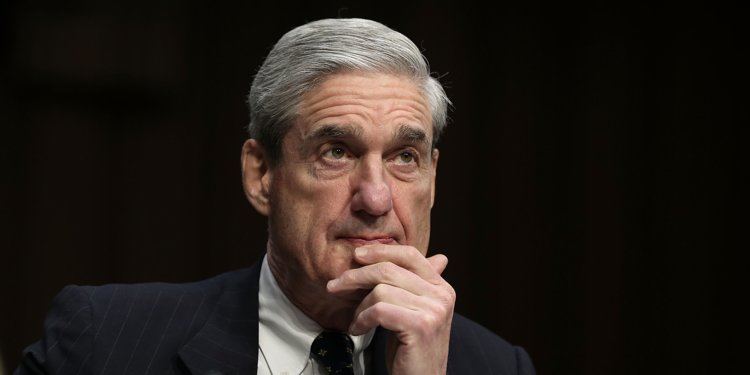
Robert Mueller. Alex Wong / Getty Images
Papadopoulos Sentenced, But All Else Quiet on the Prosecutorial Front
Not Showing the Game Plan
As noted in a recent 538 article on Friday, the Mueller investigation has continued to defy predictions of an imminent wrap-up, or alternatively, of imminent indictments (some had been speculating that Roger Stone, Donald Trump Jr., or Jared Kushner, would be indicted around Labor Day) prior to the 60-day window before midterm elections in November, and per usual practice, it is showing no signs of tipping its hand. Although there were certain procedural details reported upon regarding Paul Manafort’s upcoming second criminal trial, the main story last week was the sentencing of George Papadopoulos, with few other substantive pieces of information being publicly revealed.
The Mystery Behind the Sentencing
George Papadopoulos, who had pled guilty to lying to the FBI on October 5, 2017 (specifically, about his relationship with the Maltese academic, Joseph Mifsud, who was a professor in London with alleged close ties to Sergey Lavrov and the Kremlin), was sentenced to 14 days in prison on Friday. As noted in the Politico article written by Gerstein, Cheney, and Meyer, “U.S. District Court Judge Randy Moss rejected pleas by Papadopoulos’ lawyers and his outspoken wife that he be spared jail time despite his guilty plea last October and thanks to his cooperation with special counsel Robert Mueller’s team.”
It’s an unusual case, because there appears so little publicly available information regarding (A) the degree to which Papadopoulos actually cooperated with the Mueller investigation, and (B) the depth of Joseph Mifsud’s involvement within the larger Trump-Russian scandal. Indeed, because Mifsud claimed that he was interviewed by the FBI in February 2017, this has led pro-Trump affiliates to make speculative assertions that Mifsud could have been an FBI plant used during the Obama Administration to entrap members of the Trump campaign. Such claims would not seem to merit serious consideration, but the fact that Mifsud has gone missing since October 2017 (the same month as Papadopoulos’s plea deal) has formed a black hole of missing information that political commentators have been quick to attempt to fill with their own theories.
However, even accepting the standard storyline that Mifsud was a bit player (with close ties to Sergey Lavrov) that Papadopoulos stumbled upon himself, there is a great deal of mystery as to how far Papadopoulos actually flipped to the prosecutors’ side, and whether there is any significant importance to it. On the surface, it appears as though Papadopoulos initially felt betrayed (i.e., hung out to dry) by the Trump campaign, and agreed to flip to the Mueller team in exchange for leniency in sentencing (with an expectation of no jail time). Later, however, it appears that Papadopoulos waffled somewhat on his agreement (and recent statements from his wife appear to back this up), and that his lack of full compliance with the prosecution may have allowed a valuable witness, Mifsud, to escape further questioning from the Mueller team.
Given the apparent situation, many pro-impeachment voices were angry at the light sentencing. Others, however, defended the approach. As Louise Mensch (a former Conservative U.K. Member of Parliament, known for her close ties to MI6, GCHQ, and the British intelligence community) noted on Twitter on Friday (at https://twitter.com/LouiseMensch/status/1038170812228952064 ), “I understand 14 days seems light for George P, but consider; he could have got probation, six months max; he melted down and tried to rid himself of the deal but then he pivoted and said he’d stick to it. I don’t know what he gave up for this, but hopefully, it was EVERYTHING.”
Storylines in the Wider Environment of Corruption
Looking beyond the Mueller investigation proper, and into the larger general atmosphere of corruption and scandal associated with the Trump Administration, a couple of other recent stories were also noteworthy: (1) possible evidence of political and moral corruption surrounding the Brett Kavanaugh confirmation hearings (regarding large credit card debts associated with MLB tickets, and stolen memos used during the Bush Administration), and (2) anonymous sourcing of incompetence and venality within he Trump Administration, both from a highly unusual New York Times Op-Ed, and Bob Woodward’s new book (drawing similarities to Fire and Fury, the book published by Michael Wolff in January 2018).
Regarding Kavanaugh, it has recently come to light (in part from a Washington Post article on Wednesday, September 5) that he had run up approximately $200,000 in credit card debt, not once, but twice, with a previous occurrence in 2006 as he was being elevated to the D.C. Circuit Court of Appeals. This is in addition to the well-known occurrence in 2016. In both cases it is unclear, given his government salary, where he received the funds to clear the debts. Moreover, there is no rational explanation why anyone in Kavanaugh’s position would run up such high debts on credit cards, and the reasoning offered behind using it to purchase season baseball tickets to Washington Nationals home games is absurd on its face.
Receiving more public coverage last week were Senator Kamala Harris’s (D, CA) aggressive questioning of Kavanaugh on Wednesday about whether he had discussed the Muller investigation with anyone from the law firm of Kasowitz Benson & Torres, possibly including Trump’s own lawyers. The tone and nature of the questioning was very strange, and it would only seem to make sense for Senator Harris to pursue such an unnecessarily hostile line of questioning if she already had received information that Kavanaugh had discussed the Mueller investigation with someone having ties to the Trump Administration. In that sense, Wednesday’s line of questioning reveals a troubling omen for Kavanaugh’s confirmation odds.
Additionally, Lisa Graves piled on more trouble for Kavanaugh on Friday, with an article published in Slate alleging that Kavanaugh had lied under oath to the U.S. Senate about stolen memos he had used during the Bush Administration. The memos had been stolen from Democrats by GOP Senate aide Manuel Miranda, but Kavanaugh denied that he had ever used them, or even that he had ever seen them. Graves provided a strong rebuttal unequivocally stating recently released emails proved that Kavanaugh not only had seen them, but was part of in depth discussions of how to handle them.
Going beyond Brett Kavanaugh, and getting even more attention in the press (and understandably so), were the troubling statements from anonymous sources about the bizarre going-ons inside the Trump White House. On Wednesday, the New York Times took the unusual step of publishing an anonymous op-ed, “I Am Part of the Resistance Inside the Trump White House.” A day earlier, on Tuesday, the media began reporting on excerpts from Bob Woodward’s new book, Fear: Trump in the White House, set to be released on Tuesday, September 11. Taken together, they provide more of the same type of coverage we’ve grown accustomed to regarding the bizarre and dysfunctional way the Trump Administration is managed. That being said, there are once again major problems with credibility (similar to the major credibility problems with Michael Wolff’s book from last January), and given the propensity of Trump affiliates for trolling the media, everything being reported should be taken with a grain of salt. In particular, the stories regarding Mattis, Kelly, and Cohn, appear on the surface to be too out of character to be true, and in situations such as these, it usually makes sense to disregard most of what is heard from anonymous sources. This is not to say that they should be ignored, given the seriousness of what is alleged, but rather, such storylines should be monitored only with a healthy dose of skepticism.
Categories: Carousel, Special Topics

 Sparrowhawk Media